
State-Level Estate and Inheritance Taxes: What You Need to Know

Many clients are familiar with the federal estate tax exemption which is high enough that most estates are not federally taxable. However, several states impose their own estate or inheritance taxes often with much lower thresholds and different calculation rules. Sixteen states plus the District of Columbia impose an estate and/or inheritance tax. Listed below in a table are the estate and inheritance tax exemption amounts and tax rates. Note the following:
- Maryland is the only state that imposes both an estate tax and an inheritance tax.
- Oregon has the lowest exemption amount at just $1,000,000.
- Connecticut’s exemption matches the federal exemption amount ($15M for 2026 and adjusted for inflation annually thereafter).
- California does not impose estate or inheritance taxes.
- Surviving spouses are not subject to state inheritance tax.
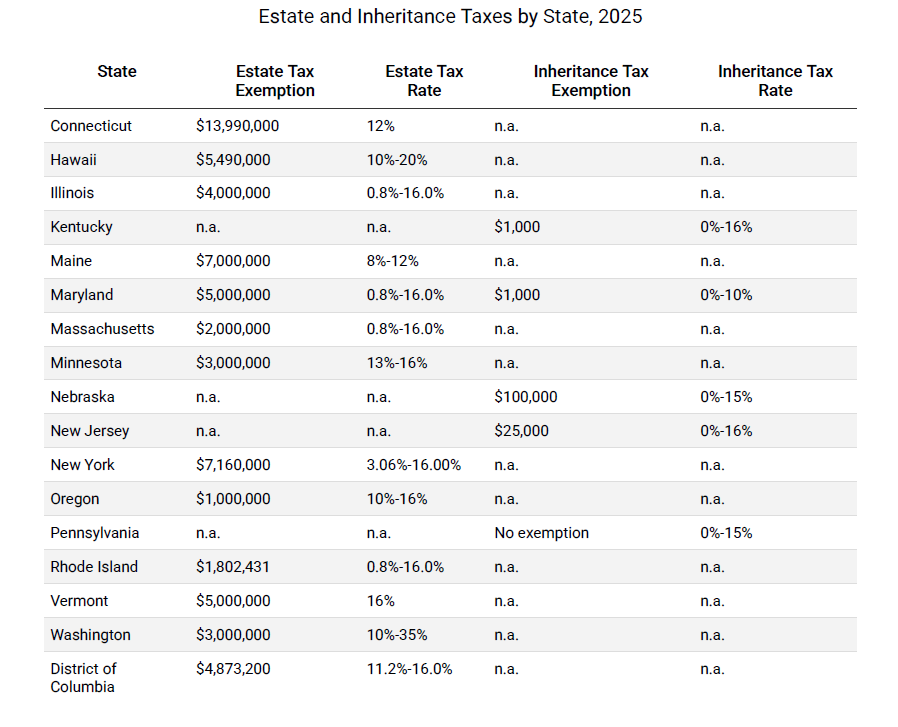
Some of the above figures have changed for 2026.
Estate Tax
At both the state and federal level estate tax is calculated on the decedent’s taxable estate. It’s paid by the estate before assets are distributed. Unlike the federal estate tax rate, states that impose an estate tax each have their own rate, with all but two (Connecticut and Vermont) utilizing a progressive bracket system where the tax rate increases with the size of the estate.
State estate tax exemptions do not always work the same way as the federal exemption. Under the federal system, estate tax applies to the taxable amount above the exemption. Some states follow a similar approach, but others use their own exemption threshold or “cliff” rules. For example, Illinois and New York have “cliff” rules that can cause your entire estate to become taxable once it crosses certain thresholds. Because of these state-specific differences, clients should not assume that only the amount above the stated state exemption will be taxed.
At the federal level, when a spouse dies, the executor of the deceased spouse’s estate may file Form 706 and elect portability, allowing the deceased spouse’s unused exemption amount (technically called the Deceased Spousal Unused Exclusion Amount) to become available to the surviving spouse. At the state level, only Hawaii and Maryland allow for estate tax portability.
If an estate is expected to be above the state estate exemption amount, a grantor could consider a Roth IRA conversion to reduce their taxable estate with the income tax paid on the conversion. The estate tax that would have been paid anyway can effectively subsidize your Roth IRA conversion and allows for heirs to inherit a more tax-efficient retirement account.
Inheritance Tax
The inheritance tax is another death-related tax that is paid directly by heirs and applies only in a handful of states. In those states, the tax applies to taxable property passing from the decedent to their beneficiaries. Whether the beneficiary owes the inheritance tax depends on where the decedent lived or owned taxable property, and how closely related the beneficiary was to the decedent. In general, closer relationships mean lower inheritance tax, with spouses paying nothing. Each inheritance-tax state has either a rate table or relationship classes to determine the rate a given beneficiary will pay.
Only five states impose an inheritance tax. In most of them (New Jersey, Kentucky, and Maryland), “Class A” beneficiaries, such as a surviving spouse, children, or parents, are exempt from paying inheritance tax (including on IRA assets). Note that Maryland does not actually use the term “Class A” but the same rule applies. The definition of “Class A” may vary by state.
The Exceptions: If the decedent legally resided in Pennsylvania, their children (over age 21) must pay a 4.5% Pennsylvania inheritance tax on inherited assets (including IRA assets if decedent was over age 59 ½). If the decedent resided in Nebraska, children (over age 21) pay a 1% tax on amounts exceeding the state’s exemption threshold.
Next Steps
It is important to note that the above information is only meant as a starting point for asking the right questions. If you reside in, inherit assets from someone who resided in, or own property in a state that imposes an estate or inheritance tax, you should consult your tax planner to review your specific situation.