
In This Issue:
The Benefits of Currency Hedging in a Strong Dollar Environment
The Huntington Fall 2015 Calendar of Events
The Benefits of Currency Hedging in a Strong Dollar Environment
The US dollar is on a tear, up over 30% over the last four years versus the benchmark trade-weighted basket of foreign currencies. This is good news for many WESCAP Group clients who frequently travel outside of the US. For example, in Europe, your 4-euro cup of coffee costs you just over $4.50 today versus almost $5.50 a year ago. (In that time, the exchange rate went from $1.37 per euro to $1.15).
For US investors, the logic is similar. If you hold non-US assets, your return on investment is affected when you translate the investment from its local currency back into dollars. With the dollar appreciating, many US investors have seen the value of their international holdings decline, at least in currency terms, as they translate their returns from a weaker foreign currency to a stronger dollar. It’s the opposite of the traveler’s discount on that cup of joe.
With the US economic recovery well underway, the Federal Reserve is gearing up to start raising interest rates, which will attract yield-seeking foreign investors to dollar-denominated assets, magnifying the dollar strength trend already in play. Conversely, central banks of most US trading partners have been cutting rates, which weakens their currencies. These divergent monetary policies have been driving US dollar strength, and we expect this trend to continue for some time.
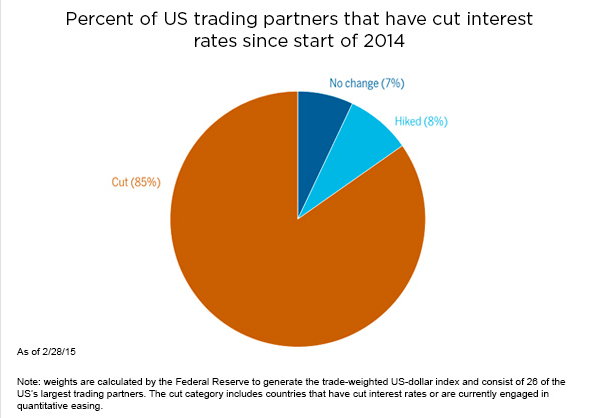
Historically, hedging currency risk has been a losing strategy for investors because currency movements are zero-sum in the long run and hedging generally costs money over time and locks in a loss (similar to buying insurance). However, the unusual differential between interest rates in Europe and Japan (low) and the US (relatively higher) has reduced the cost of hedging currency risk.
Adding a currency hedge to an international portfolio can help reduce foreign currency risk while still maintaining diversification benefits and exposure to potential growth opportunities outside the US. In many markets with interest rates lower than those in the US, currency hedging is nearly costless.
Exchange-traded funds (ETFs) offer a convenient, low-cost way to potentially hedge the currency risk of your international investments. These investments allow us to own assets in markets where we expect better than US stock market returns (such as Europe and Japan) while hedging away the aforementioned currency risks of the euro and yen.
Click here to read PIMCO’s Viewpoint piece “Three Reasons the Dollar Should Stay Strong”
Active, Passive, or Smart Beta Strategies – Which is the Best Investment Approach for Your Portfolio?
With the sustained strong performance of the US stock market since the end of the 2008 financial crisis, many investors have placed more and more of their portfolio assets into “passive” index mutual funds and exchange traded funds (ETFs) designed to track the S&P 500 Index and other stock market proxies. Consequently, some of the largest and most successful “actively” managed mutual funds have seen significant outflows as investors have given up hope that these funds can outperform their cheaper passive fund counterparts. Meanwhile, new variations of “smart beta” funds seem to be introduced regularly and are also gaining interest with investors. So what are these different investment strategies and which is the best approach for one’s portfolio?
The attached article discusses the key differences between active, passive, and smart beta investment strategies and some of the major benefits and weaknesses of each. It addresses some of the main factors investors need to consider while evaluating when to use each strategy and why it may make sense to maintain a portfolio combining investments from all three approaches.
Click here to read WESCAP Group’s whitepaper “Active, Passive or Smart Beta Strategies?”
Our Fiduciary Duty To You
We believe in placing our clients’ best interests first. Therefore, we are proud to commit to the following five fiduciary principles:
- We will always put our clients’ best interests first.
- We will act with prudence; that is, with the skill, care, diligence and good judgment of professionals.
- We will not mislead clients, and we will provide conspicuous, full and fair disclosure of all important facts.
- We will avoid conflicts of interest whenever possible.
- We will fully disclose and fairly manage, in our clients’ favor, any unavoidable conflicts.
Click here for a copy of our Fiduciary Oath signed by all six WESCAP Group Financial Advisors Most brokers and their managers (often called “Financial Advisors”) will not sign this oath, as they and their firms will be committing perjury by doing so.
Click here to read the WSJ article “Fiduciary or Broker? Many Financial Advisers Wear Both Hats”
Check Your Credit Report
We encourage all of our clients to check their credit reports at least annually in order to identify any potential issues or identity theft. The nationwide credit reporting companies (Equifax, Experian, and TransUnion) are required by The Fair Credit Reporting Act to provide you with a free copy of your credit report once every 12 months if you request it.
Click here to request your free credit report today
We suggest that you do not contact these companies directly as they will try to up-sell other services.
Please contact us if you have questions about your credit report.
The Huntington Spring-Summer 2015 Calendar of Events
WESCAP Group is a proud charitable partner with The Huntington Library, Art Collections, and Botanical Gardens. The Huntington is home to one of the finest research libraries in the world, a splendid art collection, and an array of botanical gardens with plants from around the world.

Fall 2015 brings an exciting array of cultural events at the Huntington.
Click here to see The Huntington’s upcoming calendar of events
Learn more about The Huntington at www.Huntington.org or by contacting your WESCAP Group financial advisor to arrange a complimentary visit or private docent-guided tour.
WESCAP Group is a Registered Investment Adviser and Fee-only financial advisory firm. WESCAP Group has been serving individuals and families since 1988.
Disclaimer: All answers and explanations are for informational purposes only and not for the purpose of providing legal or binding advice. Please contact your advisor to discuss your specific concerns/needs.